
Doing regular checks and attending appointments when something feels off is crucial to staying healthy.
It is about prevention, early detection, looking after mental wellbeing and feeling confident enough to ask for help when something does not feel right.
However, over 40% of men only seek medical help when they believe a condition is serious, which can lead to delayed diagnoses and poorer long-term outcomes.[1]
Many serious health conditions, including heart disease, type 2 diabetes and some cancers, can develop with few or no obvious symptoms in their early stages.
Regular health checks, awareness of changes in the body and open conversations with healthcare professionals can help men take control of their health and, in some cases, save lives.
But too many men are missing out on vital health checks.[2]
The NHS Health Check was introduced to help prevent, detect, and manage life-threatening illnesses such as cardiovascular disease (CVD).
Although data on NHS Health Checks broken down by sex is not recorded, only 34.7% of people invited for a check actually took up the invite.[3]
According to a survey by patient feedback body Healthwatch, only 59% of men said that they were aware of the Health Check, and less than one in ten men (8%) correctly identified the Health Check eligibility.[4]
Men are also statistically more likely to die from Cardiovascular Disease (CVD).
The latest figures from the British Heart Foundation show that of the nearly 39,000 people to die from CVD in 2023, 26,679 were men (68%).[5]
The NHS health check-up is set up to catch symptoms of heart disease.
Introduced in 2009, the NHS Health Check should be offered every five years to adults aged 40–74 without a pre-existing long-term condition.
Usually, the check is carried out by a nurse at a GP surgery and includes checks on blood pressure, weight, cholesterol, and sometimes blood sugar.[6]
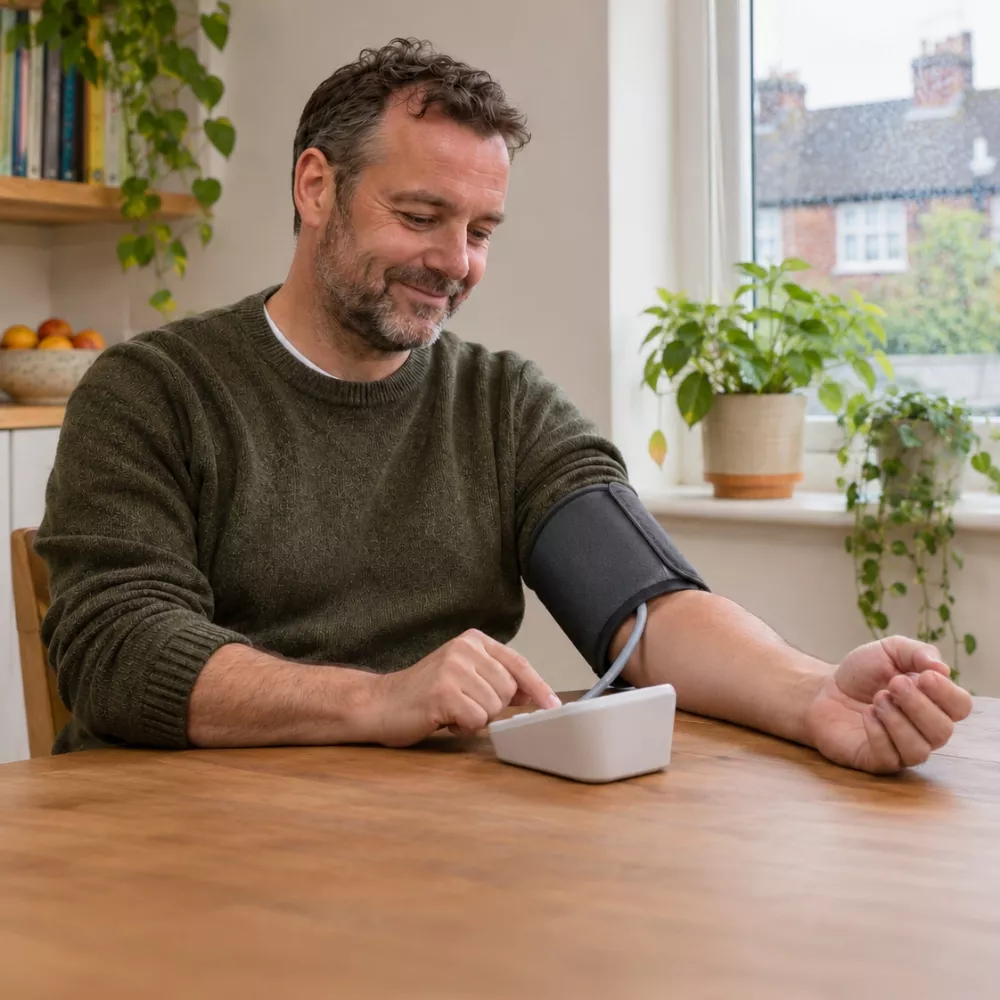
While the NHS health check is done by a medical professional there are a number of other checks men can do from home to keep on top of their health.
Firstly, regularly checking testicles can help find a testicular cancer earlier, when it is easier to treat.[7]
According to Macmillan Cancer Support, a normal testicle should feel smooth and firm, but not hard.
It can be easier to check the testicles during, or right after, a warm bath or shower when the scrotal skin is relaxed.
Hold the scrotum in the palm of your hand. Use your fingers and thumb to examine each testicle. You should feel for:
- lumps or swellings
- anything unusual
- differences between the testicles
It is normal for the testicles to be slightly different in size. It is also normal for one to hang lower than the other.[8]
Another check that can be done at home is to check your skin for signs of cancer.
The rule of thumb according to the Skin Cancer Foundation is anything that is new, changing or unusual.
If you see something is new, changing or unusual, get checked by a dermatologist right away. It could be skin cancer.[9] This includes:
- A growth that increases in size and appears pearly, transparent, tan, brown, black, or multi-coloured.
- A mole, birthmark or brown spot that increases in size, thickness, changes colour
- or texture, or is bigger than a pencil eraser. Learn the ABCDEs of melanoma.
- A spot or sore that continues to itch, hurt, crust, scab or bleed.
- An open sore that does not heal within three weeks.
Other checks include the regular bowel cancer screening, where the NHS invite people aged 54 to 74 years for bowel cancer screening every two years[10], and checking for prostate cancer.
Prostate cancer can change the way you pee, such as[11]:
- finding it difficult to start peeing or straining to pee
- having a weak flow of urine
- “stop-start” peeing
- needing to pee urgently or often, or both
- feeling like you still need to pee when you’ve just finished
- peeing during the night
The key is to know what is normal for you, act on any changes and attend preventive checks even when you feel well.
Home checks are useful, but they do not replace professional advice, screening or NHS Health Checks.
Taking control of your health does not have to mean making major changes overnight.
Start with one simple step: check whether you are due an NHS Health Check or screening appointment, carry out regular self-checks and speak to a healthcare professional if something does not feel right.
Seeking help early is not overreacting, it is one of the most important things you can do to protect your health and wellbeing.
Join HMCA Today
If you are a member of a group and are interested in becoming a HMCA member, contact the friendly team in Knaresborough by telephone on 01423 799949 or visit hmca.co.uk.
[1] LGA response to DHSC’s call for evidence: Men’s Health Strategy for England | Local Government Association
[2] Time to get serious about men’s NHS Health Checks | Healthwatch Hammersmith and Fulham
[3] NHS Health Check – Data | Fingertips | Department of Health and Social Care
[4] https://www.healthwatch.co.uk/blog/2025-09-18/time-get-serious-about-mens-nhs-health-checks
[5] Heart & Circulatory Disease Statistics 2025
[6] Time to get serious about men’s NHS Health Checks
[7] How to check for testicular cancer | Macmillan Cancer Support
[8] How to check for testicular cancer | Macmillan Cancer Support
[10] https://www.england.nhs.uk/long-read/your-guide-to-nhs-bowel-cancer-screening/
[11] https://www.nhs.uk/conditions/prostate-cancer/symptoms/